In this guide
- Confirm the destination before the path Check the exact facility, department and destination through the approved source. A service name can appear in more than one location. Do not infer the destination from a familiar clinician's name, a partial message or the building where a similar service used to be.
- Use a short sequence with stable landmarks Explain the first action and the next meaningful turning point. Prefer official signs and stable landmarks to employee shorthand. “Use the signed entrance for this department” is more useful than “go where the old office was.” The exact wording depends on the actual place and current instructions.
- Ask about the person's practical needs Do not assume someone can use stairs, hear a spoken instruction or read a small sign. Ask how you can make the direction usable and follow the approved assistance process. Avoid touching mobility equipment or physically guiding a person without the appropriate consent, training and local procedure.
- Check your explanation, not the person's ability AHRQ's teach-back resources emphasize checking whether an explanation has been understood. For nonclinical directions, you can ask the person to describe the first step so you can make sure you were clear. This publication does not train staff to teach clinical instructions outside their role.
- Know when a map is no longer enough A closed entrance, changed destination or unclear sign may require an authorized escort or service handoff. Use the local process and confirm what has actually been arranged. Do not say someone will meet the visitor unless that person or team has accepted the request.
- Sources and scope
A route that is obvious to a daily employee can be difficult for a first-time visitor. Building names, floor labels and local shorthand may mean little to someone already worried about an appointment. Useful directions reduce the next decision the person has to make. They do not require memorizing every corridor in the health system.
Northwell's historical hospitality account describes service communication as part of the patient experience. The current local directory, signs and authorized visitor-service process remain the sources for actual directions. This article does not publish a Northwell campus map or grant access to any area.
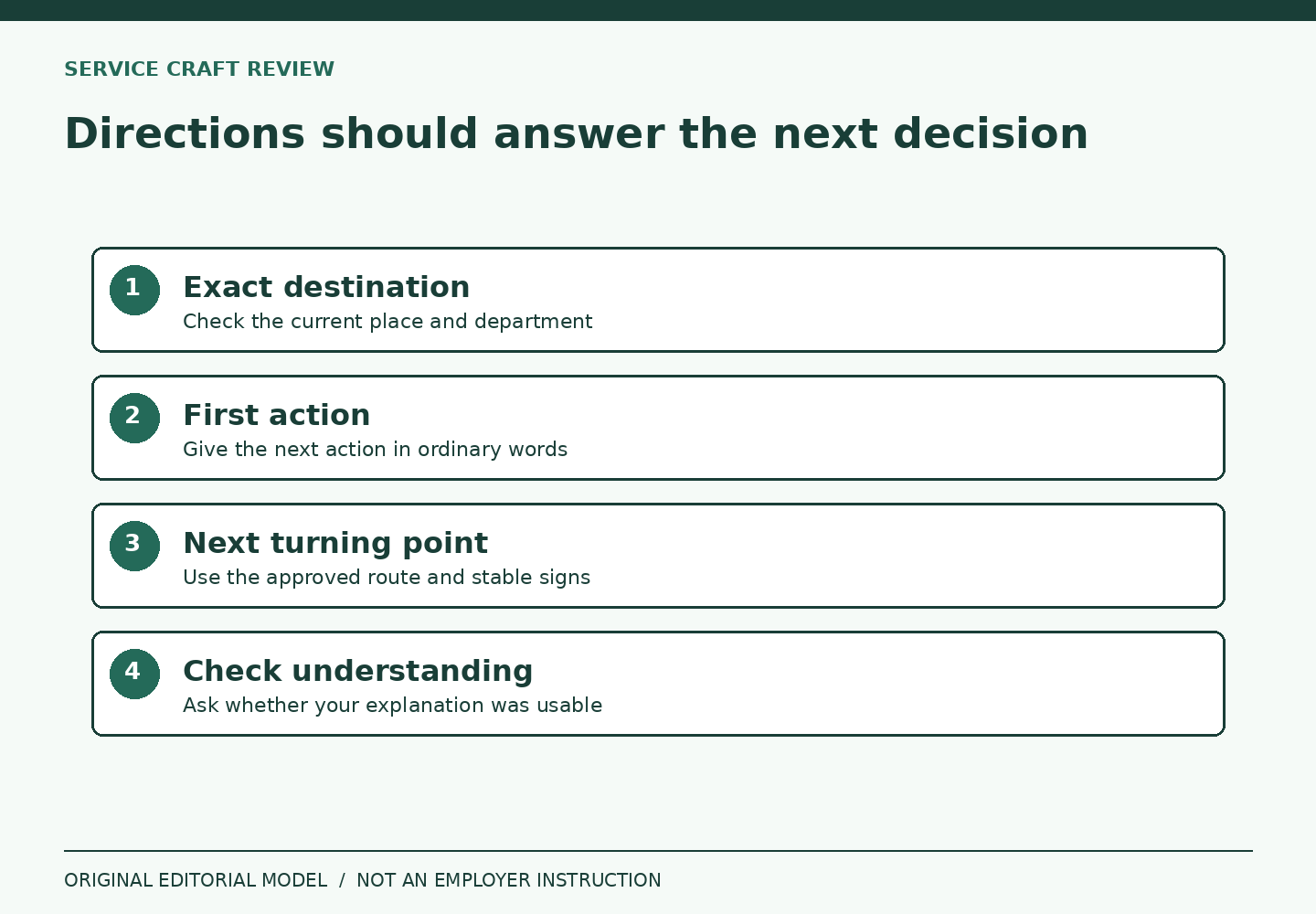
Confirm the destination before the path Check the exact facility, department and destination through the approved source. A service name can appear in more than one location. Do not infer the destination from a familiar clinician's name, a partial message or the building where a similar service used to be.
If the person has a document, follow the local process for viewing only the information needed. Do not ask them to read private medical details aloud at a public desk. When the destination is unclear, route the question to the responsible team rather than inventing a plausible answer.
Use a short sequence with stable landmarks Explain the first action and the next meaningful turning point. Prefer official signs and stable landmarks to employee shorthand. “Use the signed entrance for this department” is more useful than “go where the old office was.” The exact wording depends on the actual place and current instructions.
AHRQ's plain-language resource helps identify words that can be simplified. Simpler language should preserve the meaning of the direction, including any access condition. Do not remove an important restriction to make the instruction shorter. A visitor route and a staff shortcut are not necessarily interchangeable.
Ask about the person's practical needs Do not assume someone can use stairs, hear a spoken instruction or read a small sign. Ask how you can make the direction usable and follow the approved assistance process. Avoid touching mobility equipment or physically guiding a person without the appropriate consent, training and local procedure.
An original fictional example: the shortest route includes a stairway, while the person needs an accessible route. The correct response is to consult the current approved information or responsible service, not to improvise an alternative through a restricted corridor. Convenience does not create access permission.
Check your explanation, not the person's ability AHRQ's teach-back resources emphasize checking whether an explanation has been understood. For nonclinical directions, you can ask the person to describe the first step so you can make sure you were clear. This publication does not train staff to teach clinical instructions outside their role.
If the person repeats a different route, clarify the explanation without blame. A sign may use a term that differs from the one you used. The mismatch is useful information for the service owner and may reveal a broader wayfinding problem.
Know when a map is no longer enough A closed entrance, changed destination or unclear sign may require an authorized escort or service handoff. Use the local process and confirm what has actually been arranged. Do not say someone will meet the visitor unless that person or team has accepted the request.
The goal is a usable next step at the real turning point. A polished speech that leaves the person unsure where to go is less helpful than a short, verified explanation with an honest route to assistance.
Sources and scope
Public sources checked October 5, 2026. Dated accounts remain historical; examples and planning methods in this article are original editorial constructions.
- AHRQ: Plain Language Words
Public examples of understandable vocabulary; local approved meanings and instructions must be preserved.
- AHRQ: Teach-Back resources
Public communication-learning materials; this publication limits its examples to nonclinical explanations.
- Northwell: A 2019 hospitality-in-healthcare internship account
Historical context for service communication; the original article is not an operational standard.