In this guide
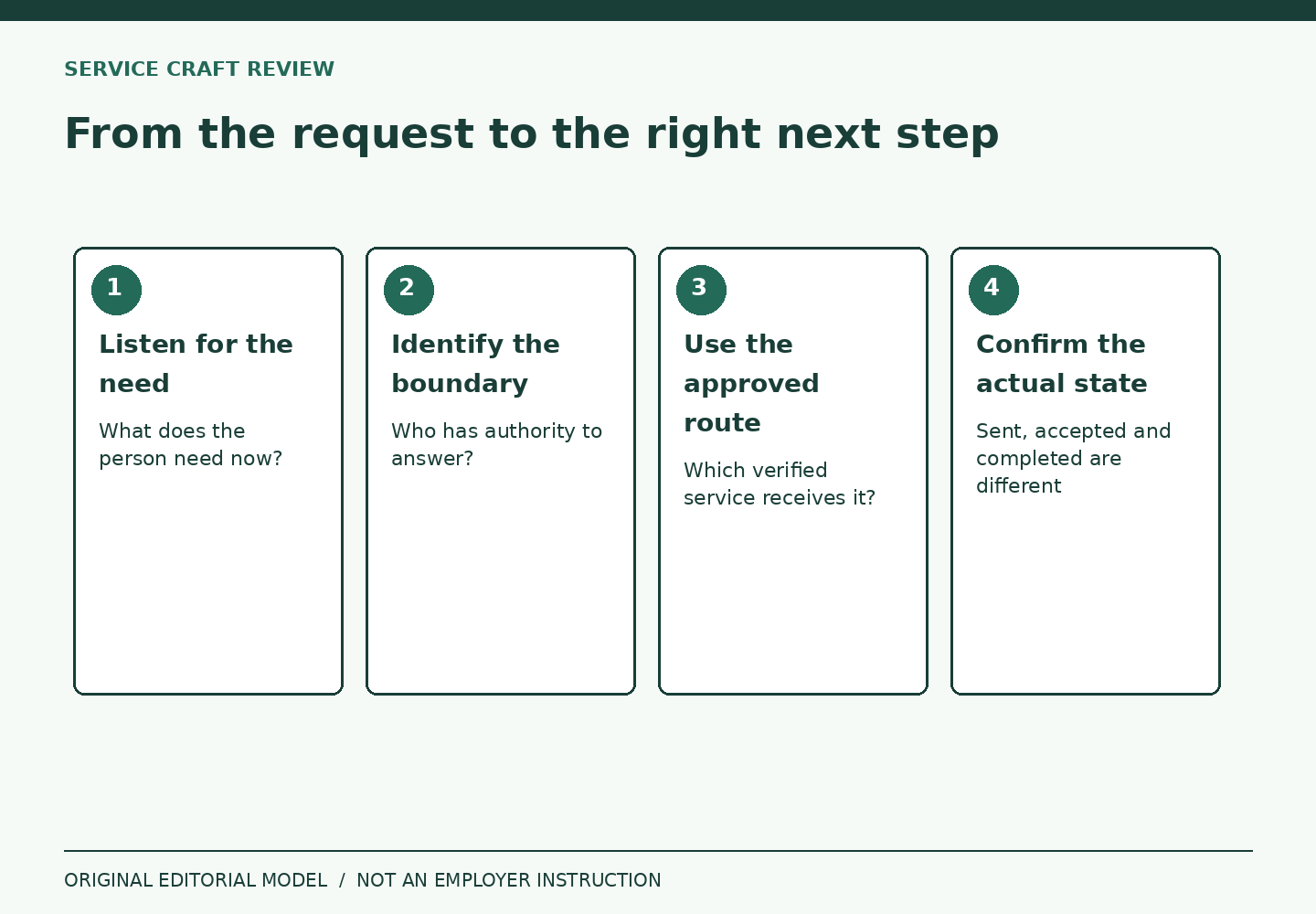
- Listen for the immediate need Allow the person to explain, then check the task in ordinary language. “Are you trying to find the appointment location, or find out whether the appointment time changed?” separates two routes without requiring a detailed medical story. Use the communication support appropriate to the person and the local process.
- Identify the authority boundary A destination question may be answered from an approved directory. A medical question needs qualified clinical staff. A record-access or disclosure question needs the authorized verification process. A waiting-time question belongs to the team that can establish the actual status. The person at first contact may connect these routes without owning every answer.
- Explain only the next step you know Say what you can verify: the approved destination, the receiving role or the action you are about to take. Do not promise a callback time, appointment outcome or service completion that another team controls. “I have sent the request” and “the team has accepted it” are different statements.
- Check that the person can act on the explanation For a nonclinical direction, ask whether the first step is clear and whether the person needs the approved assistance route. Avoid turning the check into a test of the person. The purpose is to find out whether your explanation was usable.
- End with an honest status Before closing the interaction, distinguish a direction given, a request sent and a handoff accepted. If something remains open, say what the person should expect according to the actual process, without adding a promise. Record information only where the employer requires and permits it.
- Sources and scope
A person approaching a desk may begin with a story rather than a clear request. They may be looking for a destination, waiting for an update, trying to correct a record or asking a medical question. The first useful service action is to understand what they need now. A quick answer to the wrong question can send someone farther from help.
Northwell's public nonclinical careers information and customer-service role description show that service work spans teams and settings. They do not authorize every staff member to perform every task. This independent article offers a conversation model, not a Northwell policy, clinical triage method or substitute for role-specific training.
Listen for the immediate need Allow the person to explain, then check the task in ordinary language. “Are you trying to find the appointment location, or find out whether the appointment time changed?” separates two routes without requiring a detailed medical story. Use the communication support appropriate to the person and the local process.
Avoid assuming that visible frustration identifies the underlying problem. Someone may be worried, lost, unable to hear the explanation or dealing with a changed arrangement. You do not need to diagnose the emotion to acknowledge the request. If there is immediate danger or an urgent concern, use the applicable emergency procedure rather than continuing an ordinary service conversation.
Identify the authority boundary A destination question may be answered from an approved directory. A medical question needs qualified clinical staff. A record-access or disclosure question needs the authorized verification process. A waiting-time question belongs to the team that can establish the actual status. The person at first contact may connect these routes without owning every answer.
The distinction should be helpful rather than dismissive. An original example: “I can help you find the right team for that result question. I cannot interpret the result at this desk.” The next action still needs to follow the employer's approved process. Do not improvise a personal phone number, private message or informal disclosure to make the handoff feel faster.
Explain only the next step you know Say what you can verify: the approved destination, the receiving role or the action you are about to take. Do not promise a callback time, appointment outcome or service completion that another team controls. “I have sent the request” and “the team has accepted it” are different statements.
If the route is unavailable, use the designated alternative or escalation. Repeating the same instruction louder does not resolve a blocked route. Nor does sending the person to an unrelated desk simply to move the conversation along. Make the gap visible to the authorized service owner.
Check that the person can act on the explanation For a nonclinical direction, ask whether the first step is clear and whether the person needs the approved assistance route. Avoid turning the check into a test of the person. The purpose is to find out whether your explanation was usable.
A fictional visitor might repeat the right building name but not know which entrance is intended. That is a sign to clarify the route, not proof that the visitor was inattentive. Follow current local information and do not grant access to restricted areas through a casual direction.
End with an honest status Before closing the interaction, distinguish a direction given, a request sent and a handoff accepted. If something remains open, say what the person should expect according to the actual process, without adding a promise. Record information only where the employer requires and permits it.
Good first contact is not knowing everything. It is understanding the question well enough to connect the person with the right source while preserving privacy, role boundaries and a clear next step.
Sources and scope
Public sources checked October 5, 2026. Dated accounts remain historical; examples and planning methods in this article are original editorial constructions.
- Northwell: Customer Service Representative, Melville
Official role description directly retrieved October 5, 2026: calls, documented procedures, escalation and communication with practices. It is not a local procedure or a guarantee that a vacancy remains open.
- Northwell: Non-clinical careers
Public context for the breadth of support work, not a list of permissions or a current job offer.