In this guide
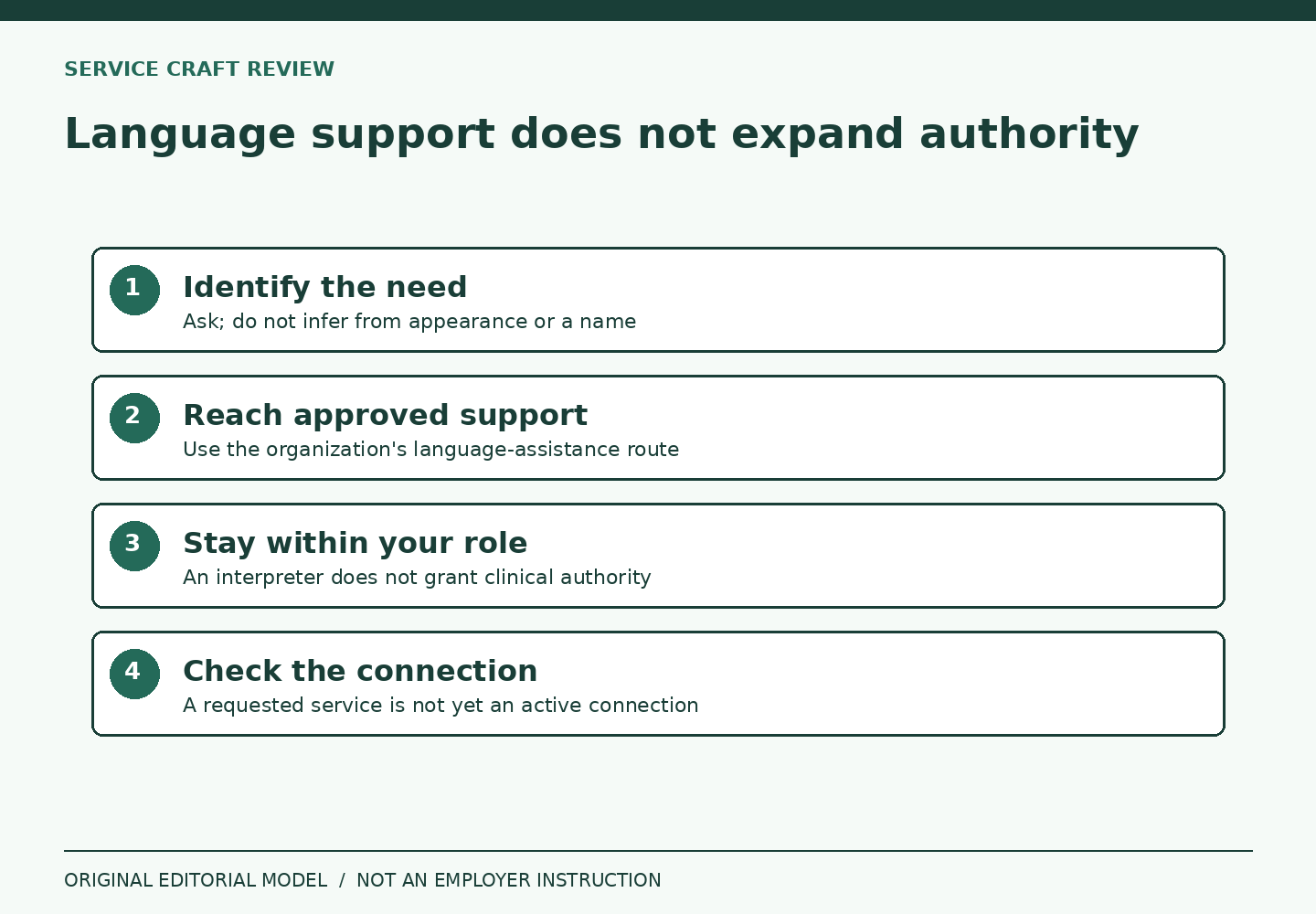
- Ask about the communication need Use the approved method to identify the language or assistance the person needs. Do not infer it from appearance, surname or a companion's speech. Address the person respectfully and avoid treating a language difference as a lack of understanding or intelligence.
- Keep informal help within its limits A bilingual colleague, friend or relative is not automatically the appropriate interpreter for a clinical or sensitive conversation. Follow the organization's policy and qualified-service requirements. Do not ask a companion to take over simply because they are present and willing.
- Preserve the actual message When using the authorized service, follow your training and keep your own statements within your role. Avoid adding an explanation about a diagnosis, treatment or benefit that you would not be authorized to give in English. Language assistance does not expand your professional authority.
- Check that the connection happened Requesting language assistance is not the same as having it available. If the usual route fails, use the designated escalation and keep the person informed of the verified next step. Do not describe a service as arranged until the process supports that statement.
- Sources and scope
A language barrier can appear in a brief direction, a form or a clinical conversation. The correct response depends on the communication need and the organization's approved services. A nonclinical Northwell employee should know how to reach the responsible language-assistance route without assuming that conversational fluency qualifies them to interpret every exchange.
Ask about the communication need Use the approved method to identify the language or assistance the person needs. Do not infer it from appearance, surname or a companion's speech. Address the person respectfully and avoid treating a language difference as a lack of understanding or intelligence.
HHS publishes general guidance on language access and effective communication. The current local process determines how staff obtain assistance. This article does not decide legal compliance or prescribe a particular service for an individual.
Keep informal help within its limits A bilingual colleague, friend or relative is not automatically the appropriate interpreter for a clinical or sensitive conversation. Follow the organization's policy and qualified-service requirements. Do not ask a companion to take over simply because they are present and willing.
Likewise, an ordinary translation application may not be approved for private information or clinical meaning. Do not enter patient content into an external tool without the organization's authorization and applicable safeguards.
Preserve the actual message When using the authorized service, follow your training and keep your own statements within your role. Avoid adding an explanation about a diagnosis, treatment or benefit that you would not be authorized to give in English. Language assistance does not expand your professional authority.
An original nonclinical example: a visitor needs to locate a department. The employee uses the approved assistance route to clarify the destination and the first step. If the conversation becomes a medical question, it moves to the qualified clinical team rather than staying at the desk.
Check that the connection happened Requesting language assistance is not the same as having it available. If the usual route fails, use the designated escalation and keep the person informed of the verified next step. Do not describe a service as arranged until the process supports that statement.
Northwell's customer-service role description includes communication with patients and practices. Clear language routing is one practical boundary in that work. The goal is accurate, respectful communication through the right resource, not a heroic attempt to answer everything personally.
Sources and scope
Public sources checked October 5, 2026. Dated accounts remain historical; examples and planning methods in this article are original editorial constructions.
- HHS: Limited English Proficiency
General language-access guidance reviewed July 2025; actual service arrangements and legal questions belong to the responsible organization.
- HHS: Effective Communication in Health Care
General official resources for communication assistance; no particular aid is prescribed for an individual.
- Northwell: Customer Service Representative, Melville
Official role description directly retrieved October 5, 2026: calls, documented procedures, escalation and communication with practices. It is not a local procedure or a guarantee that a vacancy remains open.