In this guide
- Identify the receiving responsibility A destination is not always an owner. A general mailbox may receive several kinds of requests, while only one role can answer the question in front of you. Clarify the responsible team through the approved directory or process rather than relying on a name from an old message.
- State the unresolved question A handoff becomes more usable when it names what still needs an answer. “The visitor needs the current approved destination for this appointment” is different from “Please help.” The first gives the receiver a task to assess. It does not force them to infer the issue from a long thread.
- Confirm the state your process supports Some workflows provide an explicit acceptance or assignment status. Others require a verbal or documented handoff through a designated channel. Use the method your employer requires. This publication does not prescribe an additional checkbox or a parallel tracking system.
- Explain the next step to the person Tell the person what is actually known and what the responsible process says should happen next. Do not promise that a particular employee will call, arrive or solve the issue unless that commitment is confirmed. If the next action remains uncertain, keep that uncertainty visible rather than presenting the referral as complete.
- Learn from repeated gaps through the right channel If requests regularly return because the receiving role is unclear, raise the pattern with the service owner using the approved reporting method. Keep the observation about the process and avoid collecting an unofficial set of patient cases. The problem may be a directory, responsibility boundary or status definition that needs formal review.
- Sources and scope
“I sent it over” can mean many things. A message may have reached a queue, a team may have seen it, or an authorized person may have accepted responsibility for the next step. A service handoff should make those states clear enough that nobody assumes another team is already acting when it is not.
Northwell's public patient-service navigator description includes formal handoff and assignment-tracking work. Its 2020 patient-advocacy account also illustrates connections across teams. Neither establishes the procedure for your role. Use the actual employer-approved workflow and do not add informal channels around it.
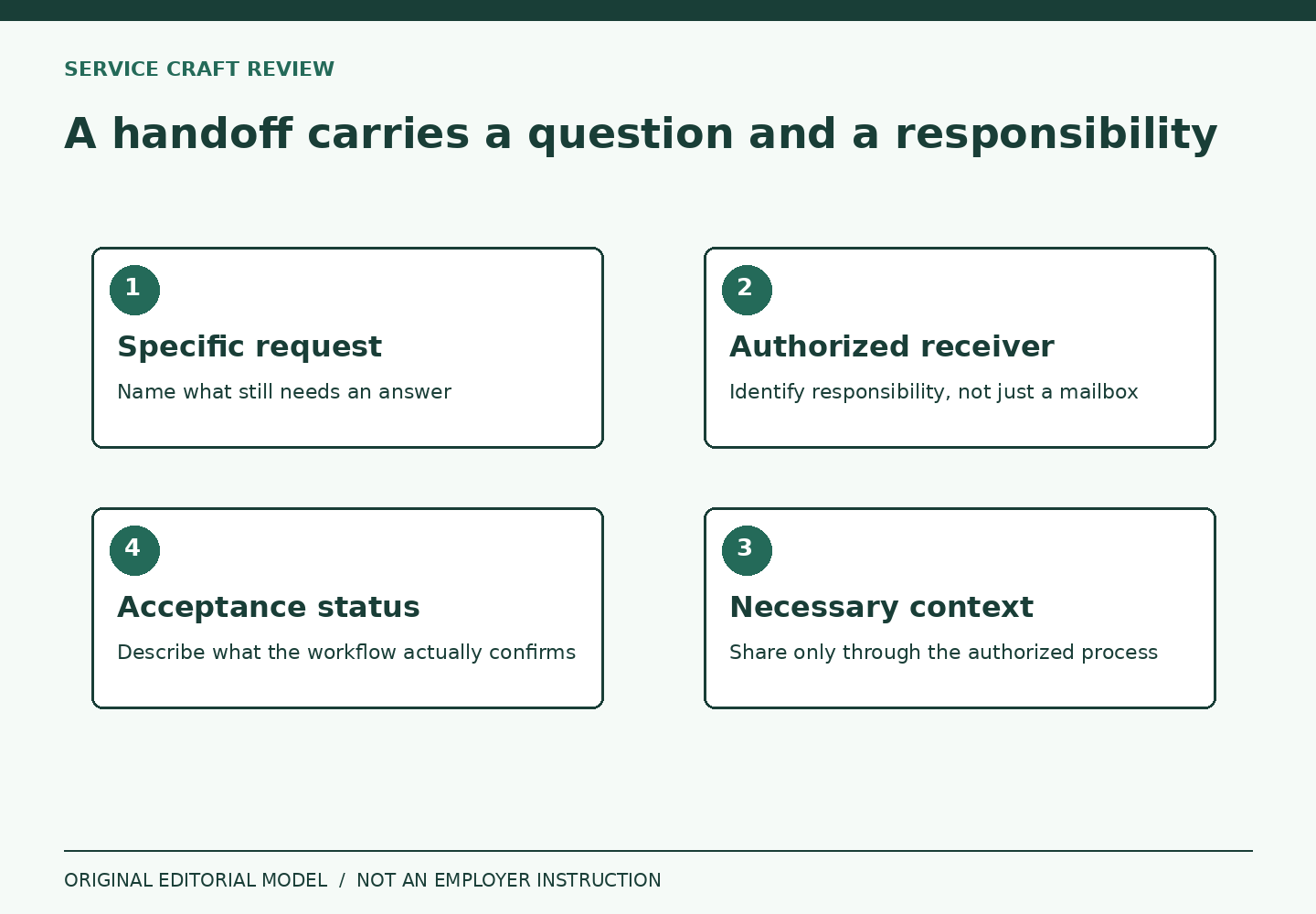
Identify the receiving responsibility A destination is not always an owner. A general mailbox may receive several kinds of requests, while only one role can answer the question in front of you. Clarify the responsible team through the approved directory or process rather than relying on a name from an old message.
The receiving role needs the specific service request and the necessary context, not a complete retelling of the person's private history. Use the authorized system and follow its information requirements. Do not copy patient data into a personal message to make the handoff easier.
State the unresolved question A handoff becomes more usable when it names what still needs an answer. “The visitor needs the current approved destination for this appointment” is different from “Please help.” The first gives the receiver a task to assess. It does not force them to infer the issue from a long thread.
In an original fictional example, a reception worker contacts the designated service because two approved references appear inconsistent. The handoff identifies the conflicting destination information and asks which source applies. It does not choose a route by guesswork or tell the visitor that the receiving team has accepted the task before that happens.
Confirm the state your process supports Some workflows provide an explicit acceptance or assignment status. Others require a verbal or documented handoff through a designated channel. Use the method your employer requires. This publication does not prescribe an additional checkbox or a parallel tracking system.
If the route is blocked, follow the authorized escalation. Do not solve the gap by contacting an unrelated colleague's private number or sending records to an unapproved address. The desire to keep a person moving does not remove security and privacy responsibilities.
Explain the next step to the person Tell the person what is actually known and what the responsible process says should happen next. Do not promise that a particular employee will call, arrive or solve the issue unless that commitment is confirmed. If the next action remains uncertain, keep that uncertainty visible rather than presenting the referral as complete.
For a medical or urgent concern, use the applicable clinical or emergency route immediately. A general service handoff is not a substitute for those processes, and this article cannot determine urgency.
Learn from repeated gaps through the right channel If requests regularly return because the receiving role is unclear, raise the pattern with the service owner using the approved reporting method. Keep the observation about the process and avoid collecting an unofficial set of patient cases. The problem may be a directory, responsibility boundary or status definition that needs formal review.
A good referral does not require one employee to own every outcome. It requires an honest account of the next responsibility and the evidence that the handoff has reached it.
Sources and scope
Public sources checked October 5, 2026. Dated accounts remain historical; examples and planning methods in this article are original editorial constructions.
- Northwell: A 2020 account of patient advocacy
Historical example of connections across service teams; no present contact, role entitlement or universal workflow is inferred.
- Northwell: Patient Service Navigator, Phelps
Official role description directly retrieved October 5, 2026: tracking, pickup instruction and destination handoff. It is not a live vacancy promise or permission to perform transport or clinical tasks.